
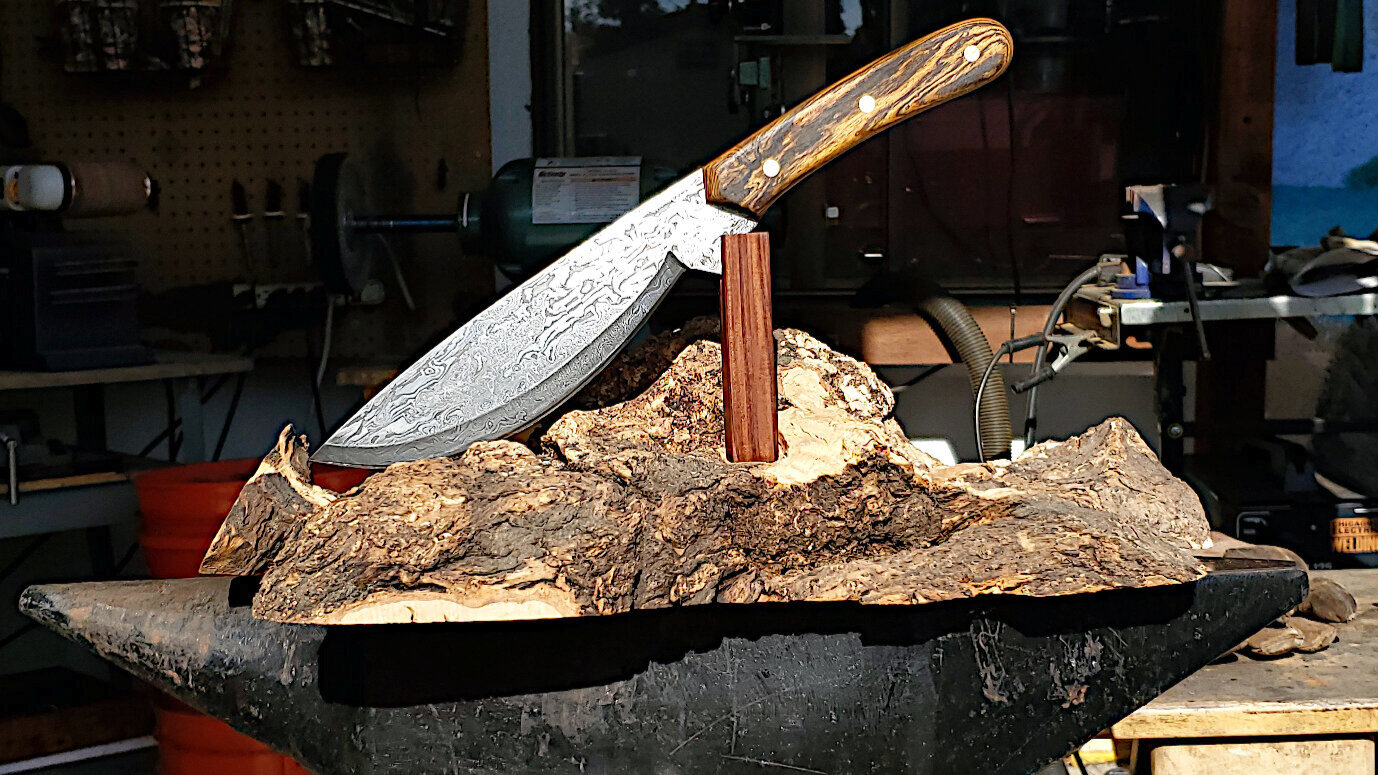
Custom Drop-point Damascus Knife
I just finished forging a Damascus-pattern drop-point knife. The following are a series of chronologically-ordered photos showing the evolution of steel bars to blade with brief, descriptive captions:

I began with these bars of 15N20, and 1084 steel my friend ordered online for me.

I cleaned up the bars on a belt sander, then marked and cut the pieces to prepare them for the forge.
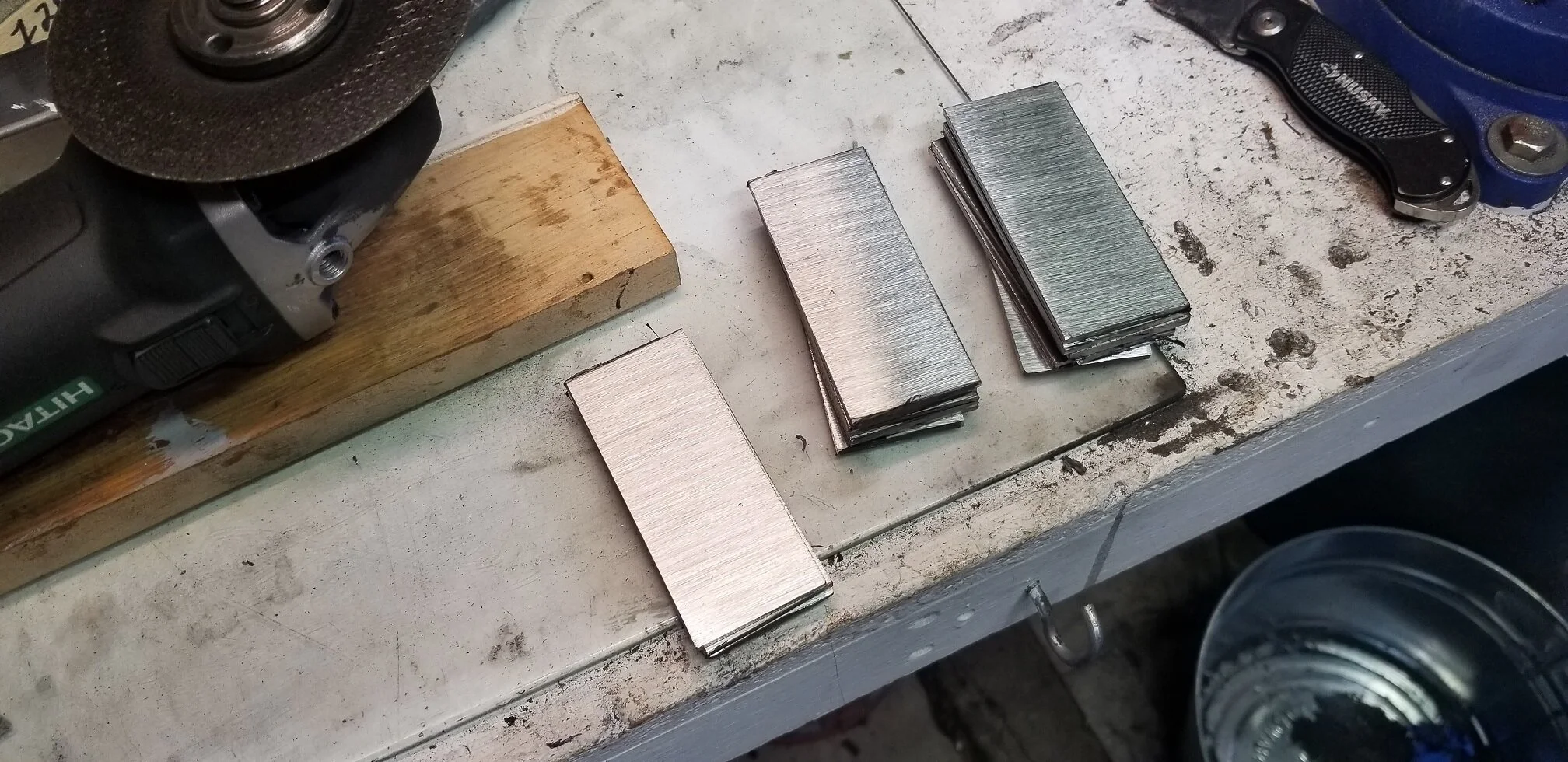
Here the steel is cleaned, cut, and organized by alloy type.

The next step is to spot weld the pieces together. Here I’ve stacked the alloys the way I wanted (alternating between 15N20, and 1084, with two bars of the same alloy in the middle. The bottle on the right contains acetone, with which I’ll clean each piece of steel before welding them together.

Here I’m spot welding the pieces together (I should be wearing gator sleeves to protect my skin from the UV radiation).
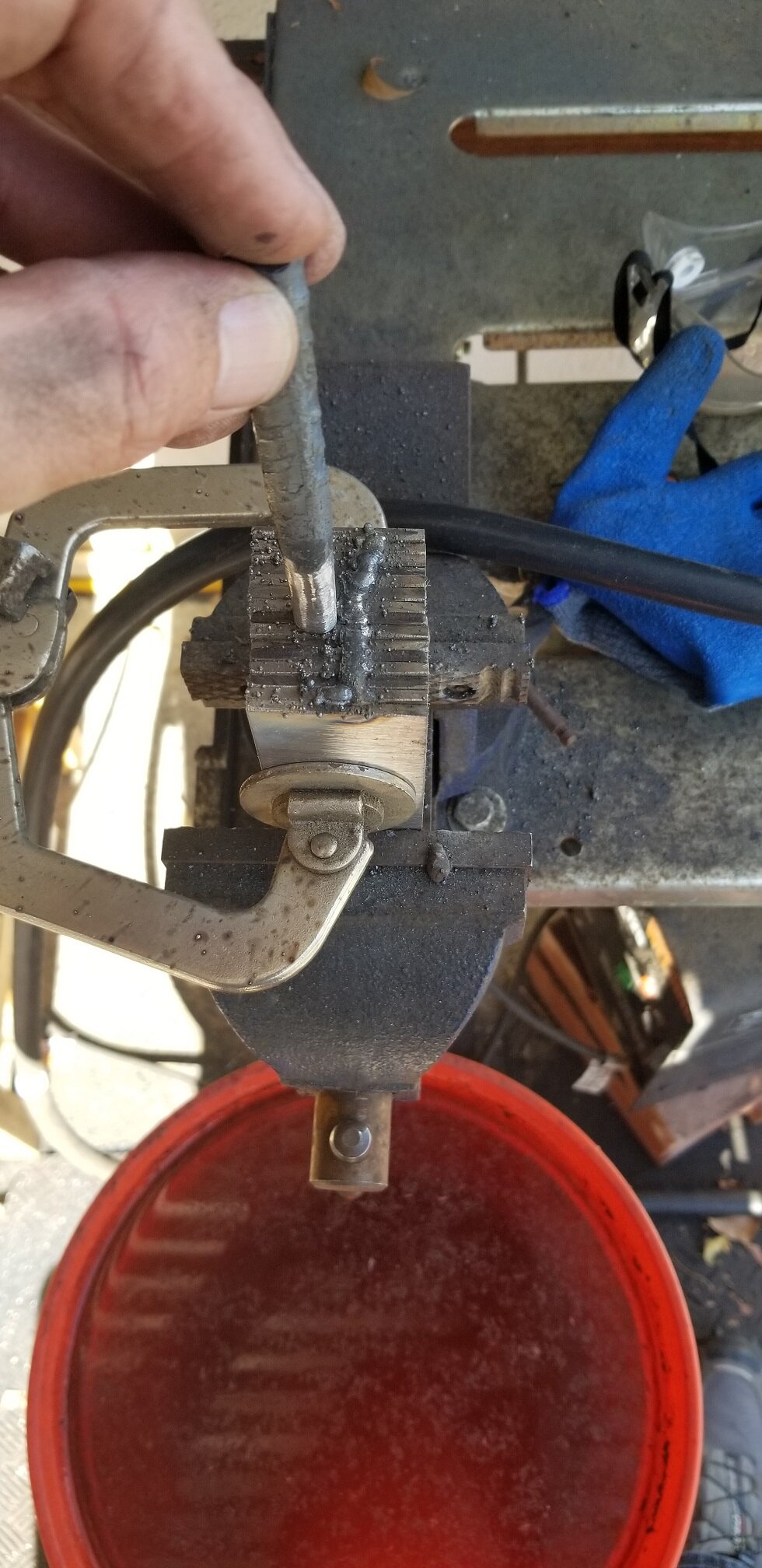
Here the pieces are welded together, and I’m about to weld on a temporary handle to make it easier to grab the steel with tongs when forging.

With the handle welded on, and steel welded together, I allowed the piece to cool then dipped it in kerosene. The kerosene will add carbon to the steel, thereby making it harder & stronger.

Covered in kerosene, I carefully slip the steel into the forge and heat it to a dull orange color.
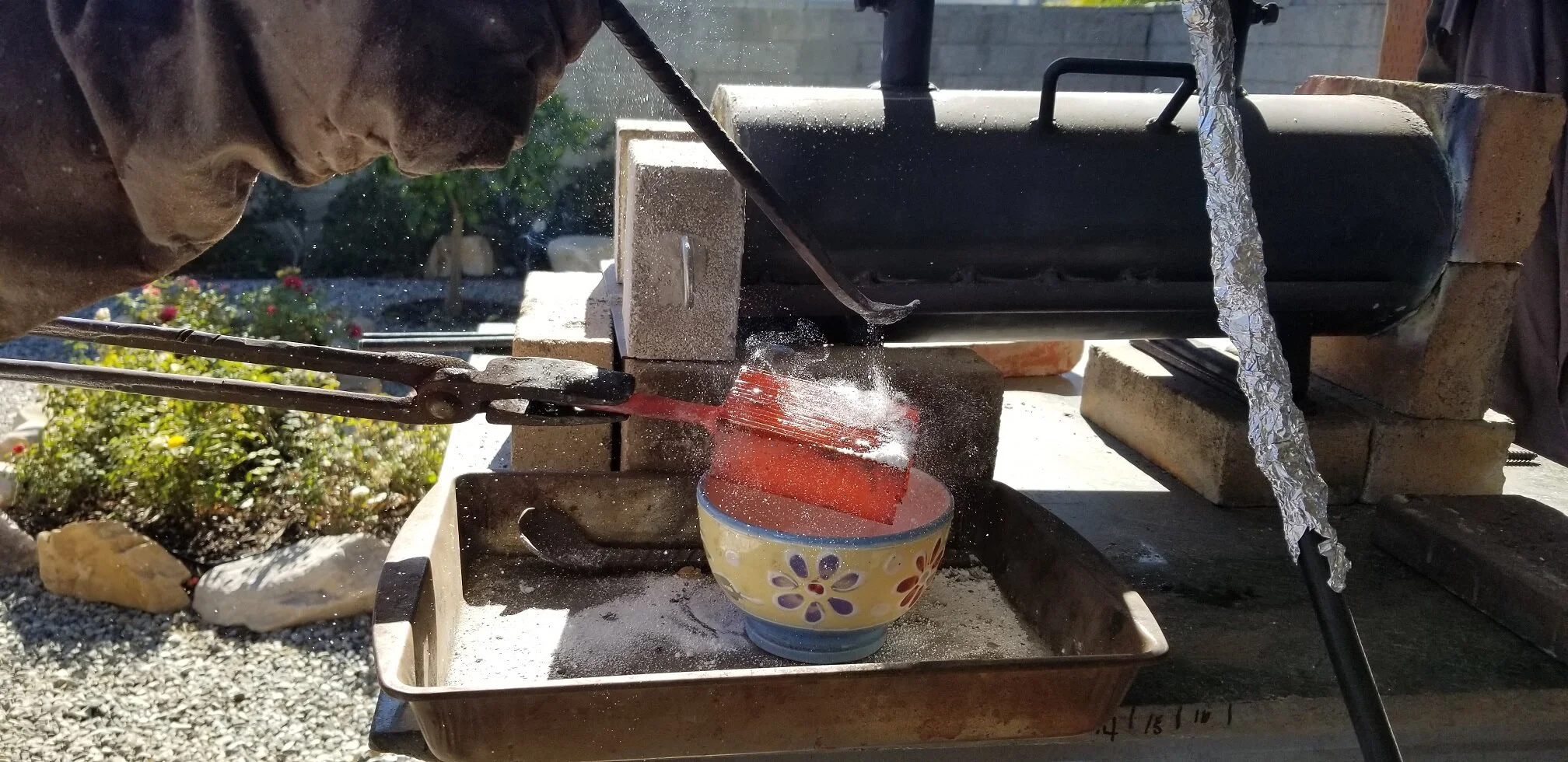
This isn’t nearly hot enough to take to the anvil, but plenty hot to add a little flux. Here I’m sprinkling a little borax on the steel. This melts upon contact and seeps between the welded bars.
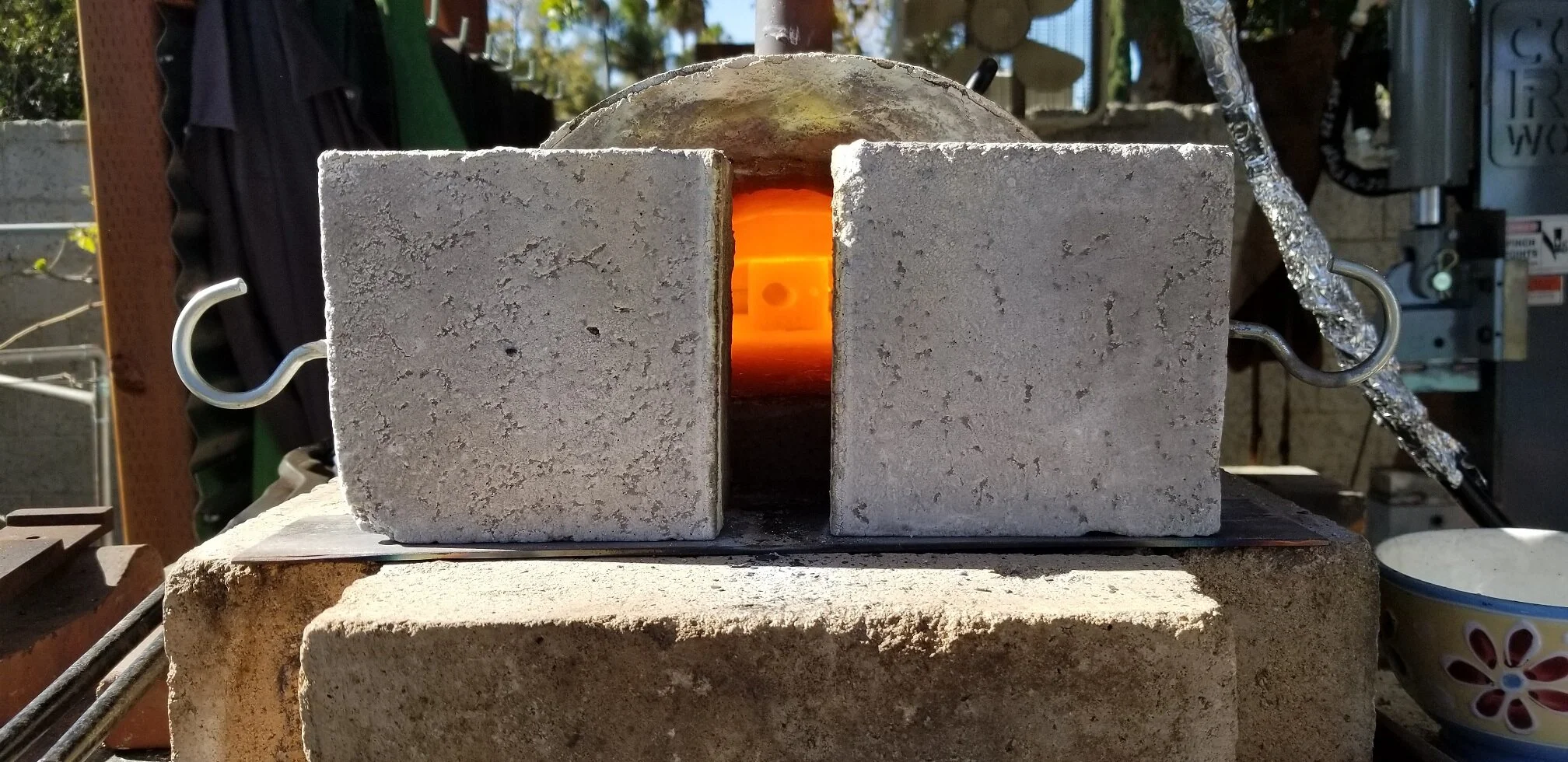
The next step is to put the it back in the forge and heat it to forge-welding temperature. I don’t know what that temperature is, but I know what the steel should look like. I want it evenly heated with a nice yellow glow; orange is too cool, white is too hot.. Forge welding requires the right temperature, and the right power behind each blow from the hammer. It’s like the story of Goldie Locks.. hit it too hard, or too soft, and the bars won’t forge together. You have to hit it just right, and I’ve got a pretty good feel for what that is with a 1500-gram hammer.

This was the final blow.. As can be seen, the bars are already forged into a single piece of steel.

Using a 16-ton forging press to draw out the billet using different dies.

Here I’m putting the piece in a vice to twist the steel..

This will give the billet a unique pattern as the two alloys are twisted throughout. A billet this size takes some effort, and I actually broke the tool, and a bolt that was holding the vice in place! I quickly fixed the breaks, and got back to twisting.
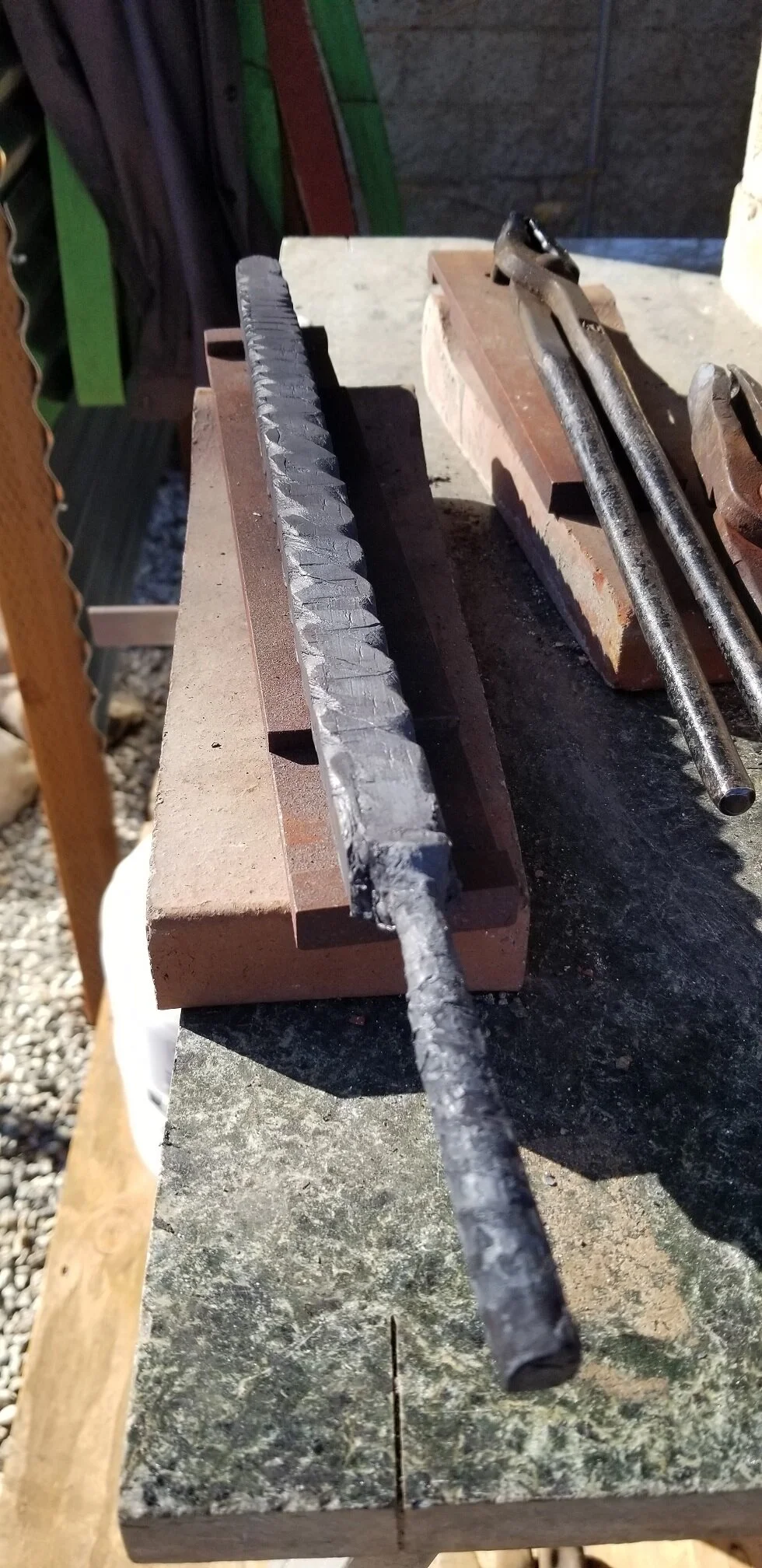
Once twisted, I reheated the piece, then hammered it out square. Here the piece isn’t squared out fully yet, but this is the only photo I have at this stage.

Here I’m cutting the squared piece into 4 equal-length pieces.

I marked each piece so I can mix them up before forge welding them back together. I flipped some in opposite directions, turned them over on a different side, and rearranged their order. This will randomize the pattern when it comes time to etch.

With the pieces reorganized, I put them in the vice, spot welded them together, welded a new temporary handle (a small piece of rebar), then dipped it in kerosene and put it all back in the forge.
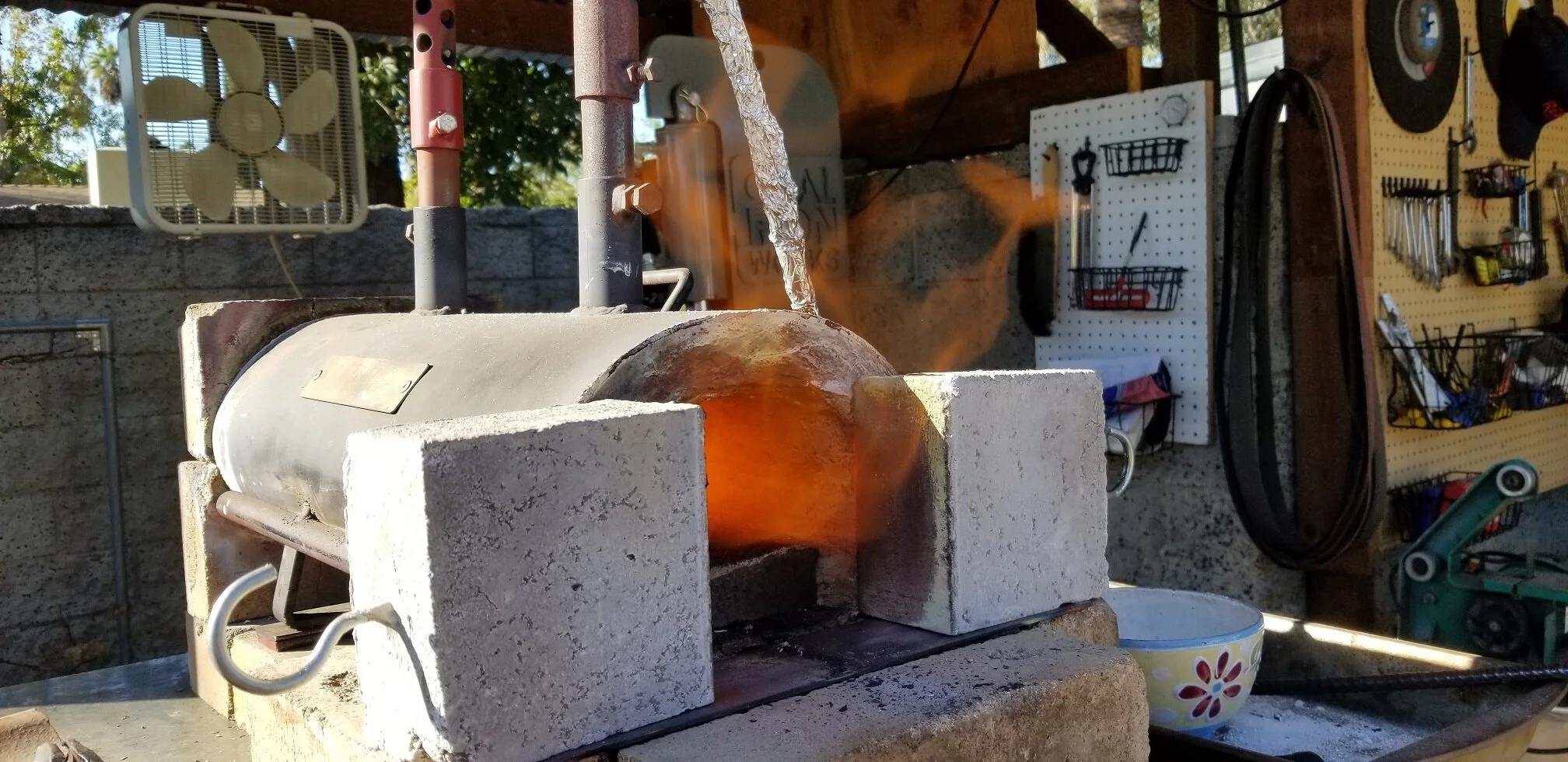
Here I’m heating the pieces just enough to add a bit more flux (not pictured).

At the right temperature, and with the right amount of power, I was able to forge weld these pieces back into a single billet of steel.

It looks like 4 pieces of steel, but this is a single chunk of metal now..

Cooling off the tongs.. they were getting a bit too hot to handle, even with gloves!

The next thing I did was to reheat the steel, then put it back in the vice, and give it more twists; this time I twisted 180 degrees one direction, then moved up a few centimeters and twisted the steel 180 degrees in the opposite direction.. I repeated this through the length of the steel, and this is what it looked like after it cooled.

Back in the fire!

At this point, I decided I wanted to add a ladder pattern to the steel. Neither my friend nor I have a milling machine, so I simply cut into the steel using a handheld grinder. While a ladder pattern was intended, I ended up forging the steel out too thin. So I had to cut it into two new pieces, and re-forge welded those back together. Doing this masked the ladder pattern, but it actually showed up in a really unique way later on (as will be seen below).
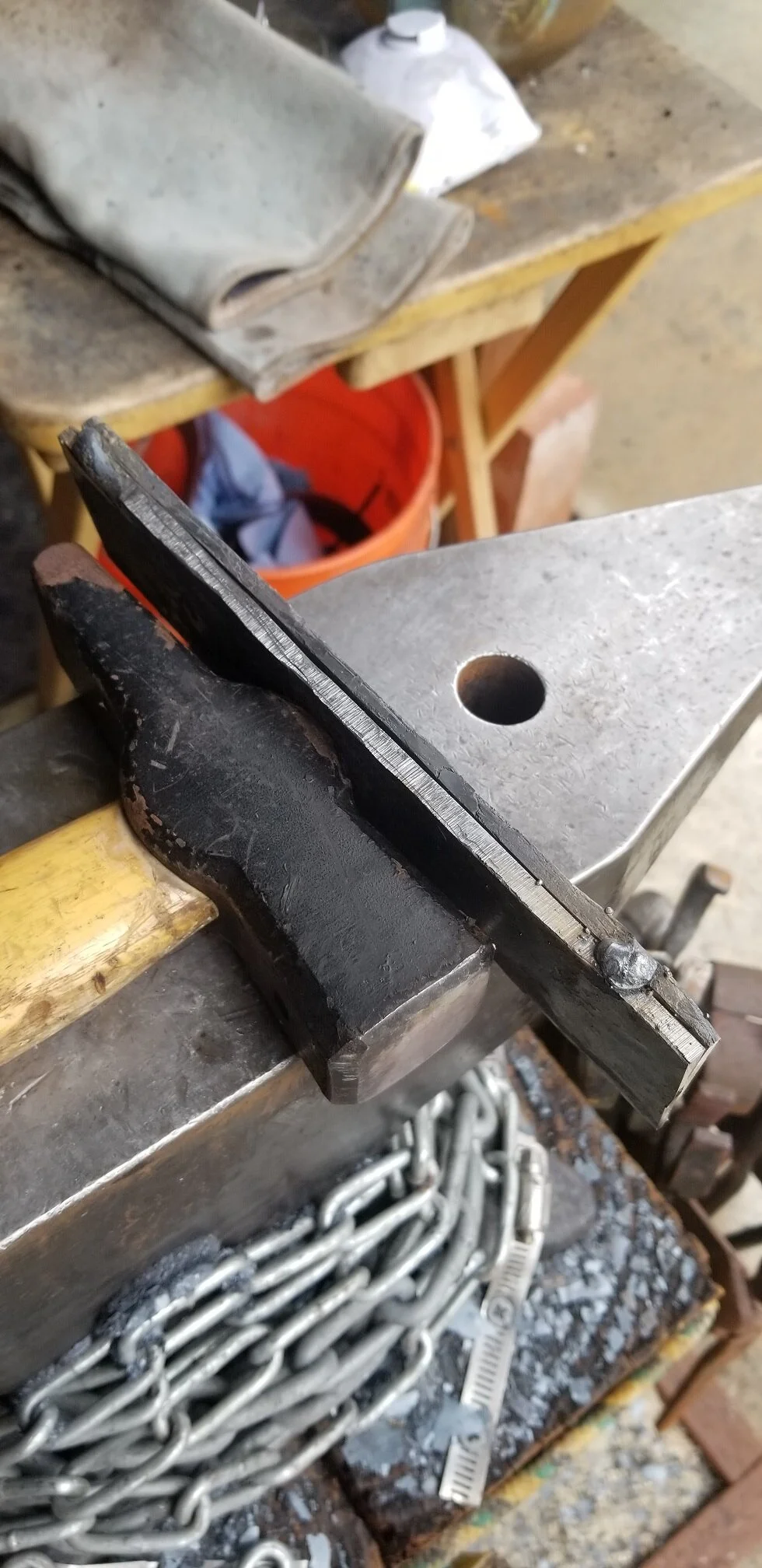
I felt the steel was too thin to make a solid knife, so I had to cut the piece in two, spot weld them together, heat them, reflux them, then re-forge weld them. :/ One interesting result of having to do this, is that the end pattern had become the most intricate of all my knives.
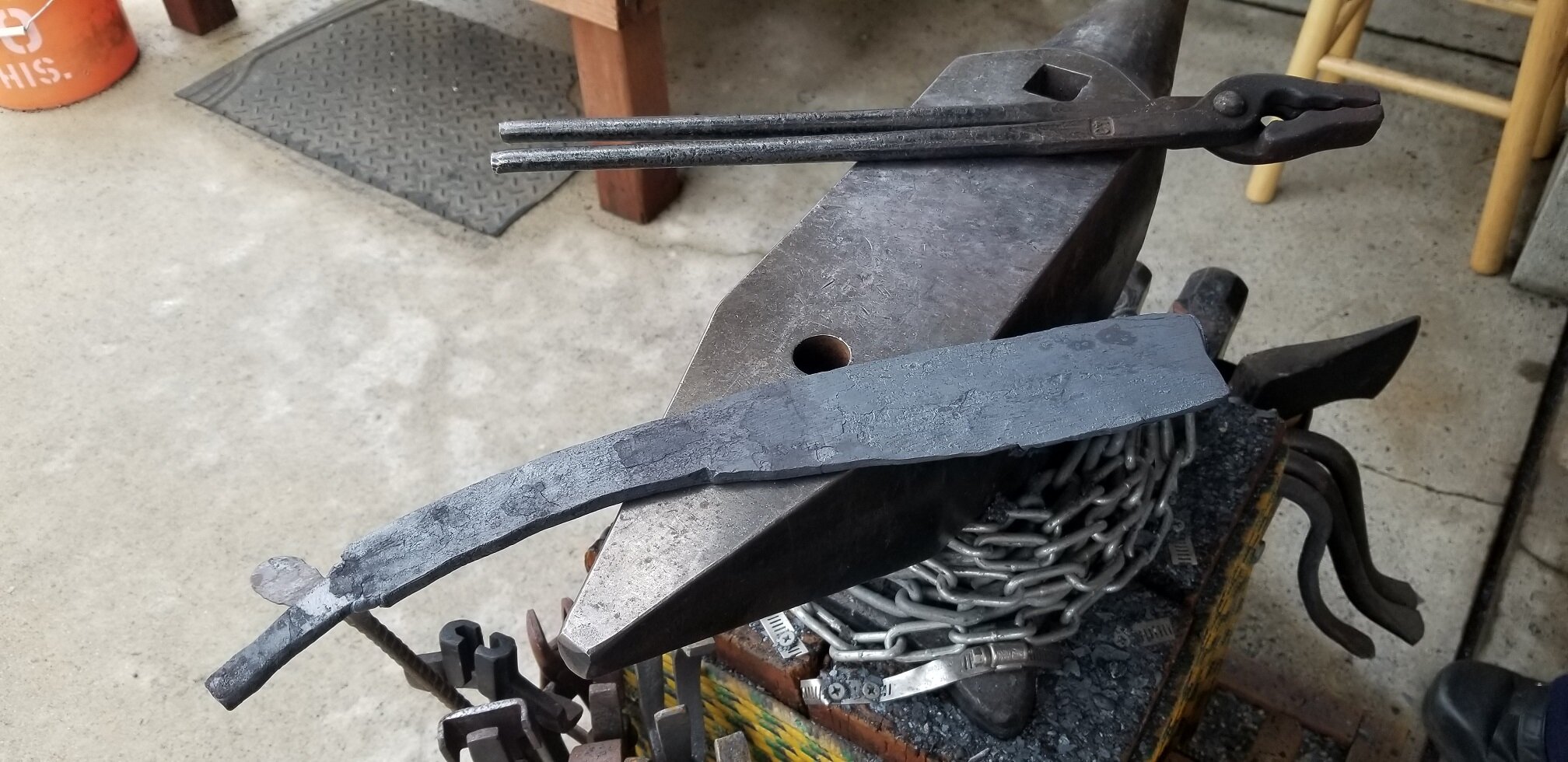
With a nice thick piece back again, I started shaping the blade on the anvil. This was after a few heats. The tang is on the left, what will become the blade is on the right.

With the general shape completed on the anvil, I brought the piece in to cut off the excess steel.

Here I marked where I wanted the handle to go with soapstone.
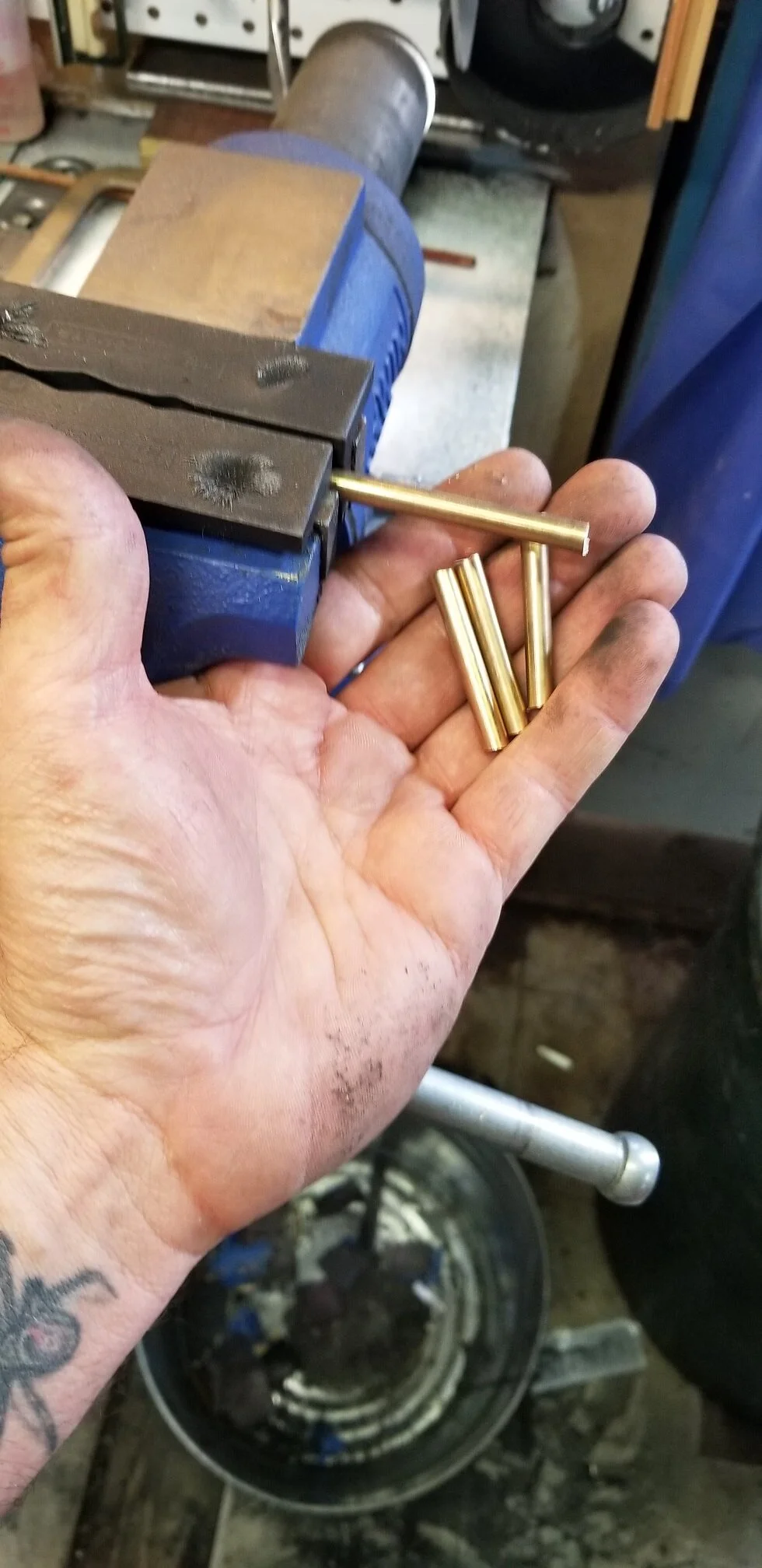
I then cut some brass dowels for securing the handle to the tang.
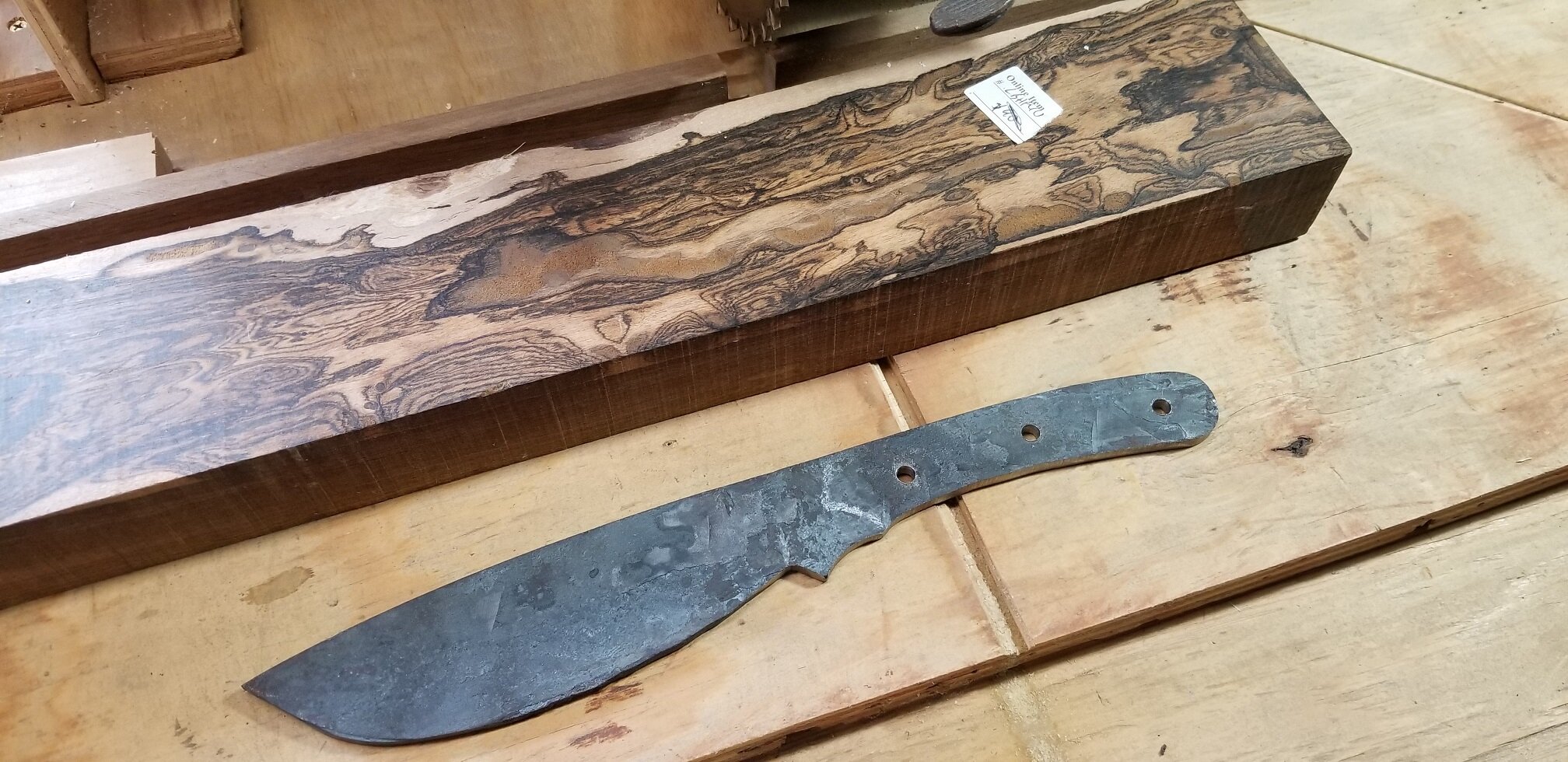
Next, I got this piece of beautiful bocote and looked for a section with a nice grain pattern; which was pretty much the entire piece!
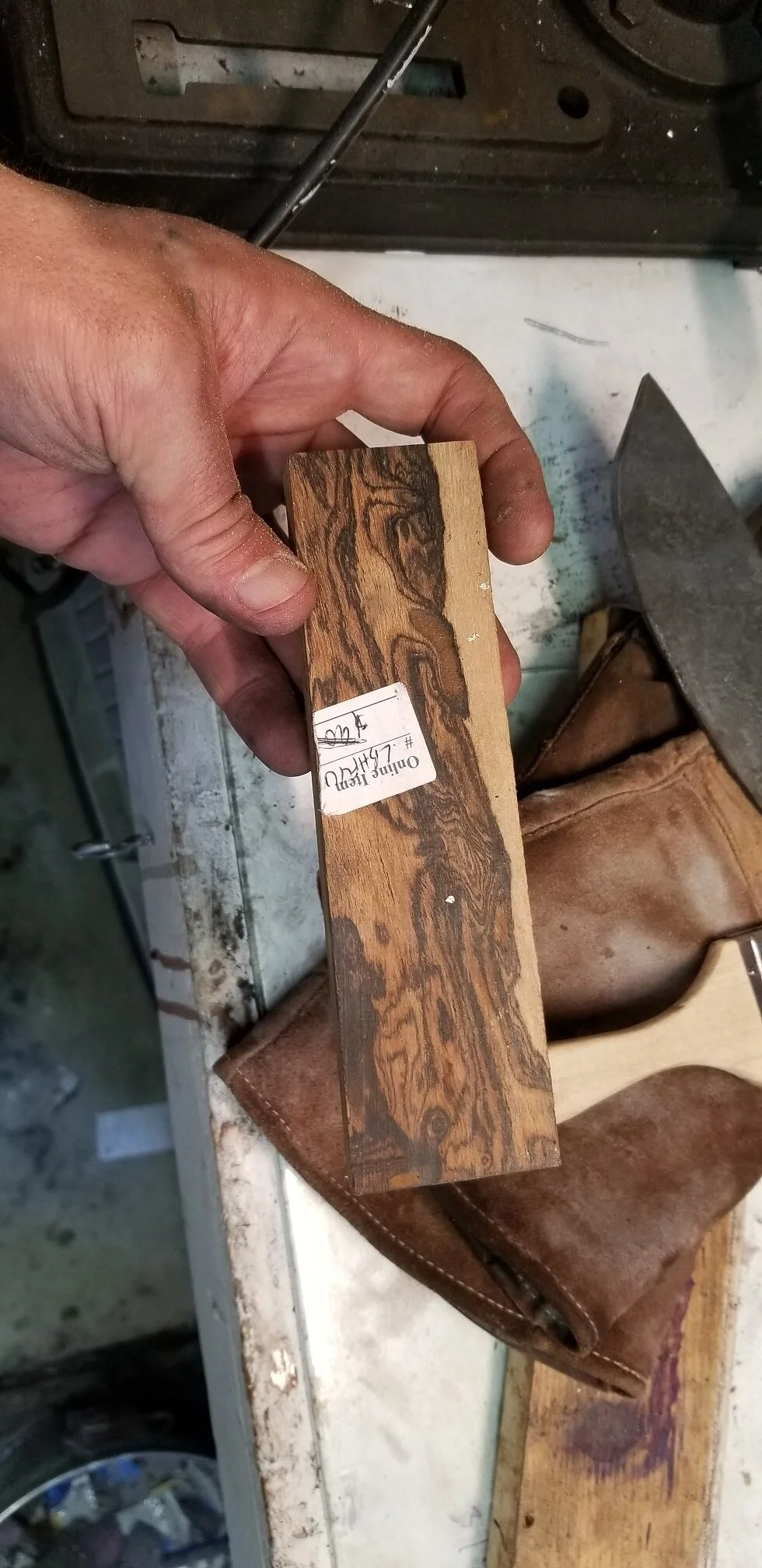
I cut this piece out on the bandsaw to use as the handle.

Using the bandsaw again, I cut out the rough shape I wanted.
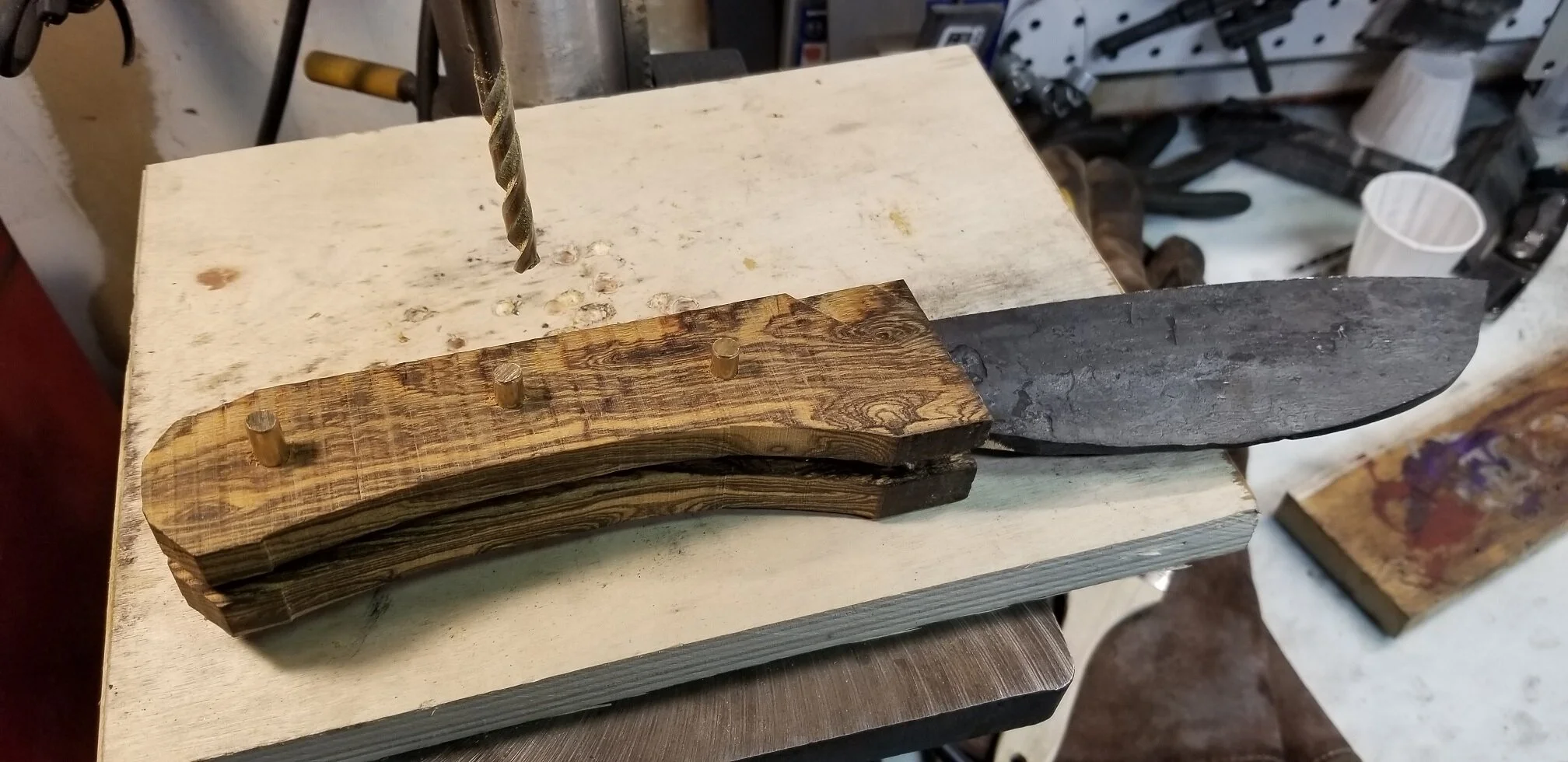
Next, I drilled out both the wood, and steel (separately), and fitted the dowels. I used a chamfering tool to on the ends of the dowels to make it easier to fit them.

Next, I dismantled the handle, set the wood and brass aside, then reheated the knife in the forge in order to heat treat it. This has to be done at the right temperature, which can be determined both by noting the color of the glow of the steel, and by holding it up to a magnet. If it isn’t attracted to the magnet, then it’s at the right temperature. At that point, I quickly submerged the entire knife into a pre-heated cooking oil. I use oil instead of water, because it cools the blade a bit slower, thus making it stronger. Then I allowed the blade to cool to the touch. Then my friend put it in the oven for 2 hours at 400 degrees F. At that point he took it out, let it cool to room temperature, then put it back in the oven for another 2 hours at 400 deg. F. This tempers the steel. Once that was done, I coated the blade in blue ink. The purpose of this is to reveal any low spots on the blade when I grind it down on the belt sander. I want the blade to be perfectly flat, but this is impossible to see with the naked eye; adding the ink makes it much easier to know when you have a flat blade on both sides.

After grinding the blade flat on the belt sander with subsequently finer, and finer grits, I next cut a bevel into the blade. I used a jig my friend made to ensure a uniform bevel along the length of the blade as seen here. I’m wearing gloves at this stage, because I intend to dip the blade in ferric chloride to etch it (I also just cleaned it with acetone, and didn’t want to get my grubby fingers all over it).

Here I’m pulling the blade out of the ferric chloride to see the pattern, and what a beautiful pattern! My girl is gonna love this!

Now it’s time to put the handle back on. To protect the blade, I wrapped it in painters’ tape. I used a 2-part epoxy to glue the handle to the tang, and inserted the brass dowels (cutting the excess off flush with the wood). Once it was all together, I clamped it together tight, using pieces of wood to protect the bocote handle from being damaged by the metal C-clamps.

Now time to hand sand the handle to the shape I desired. This takes a lot of time and patience..
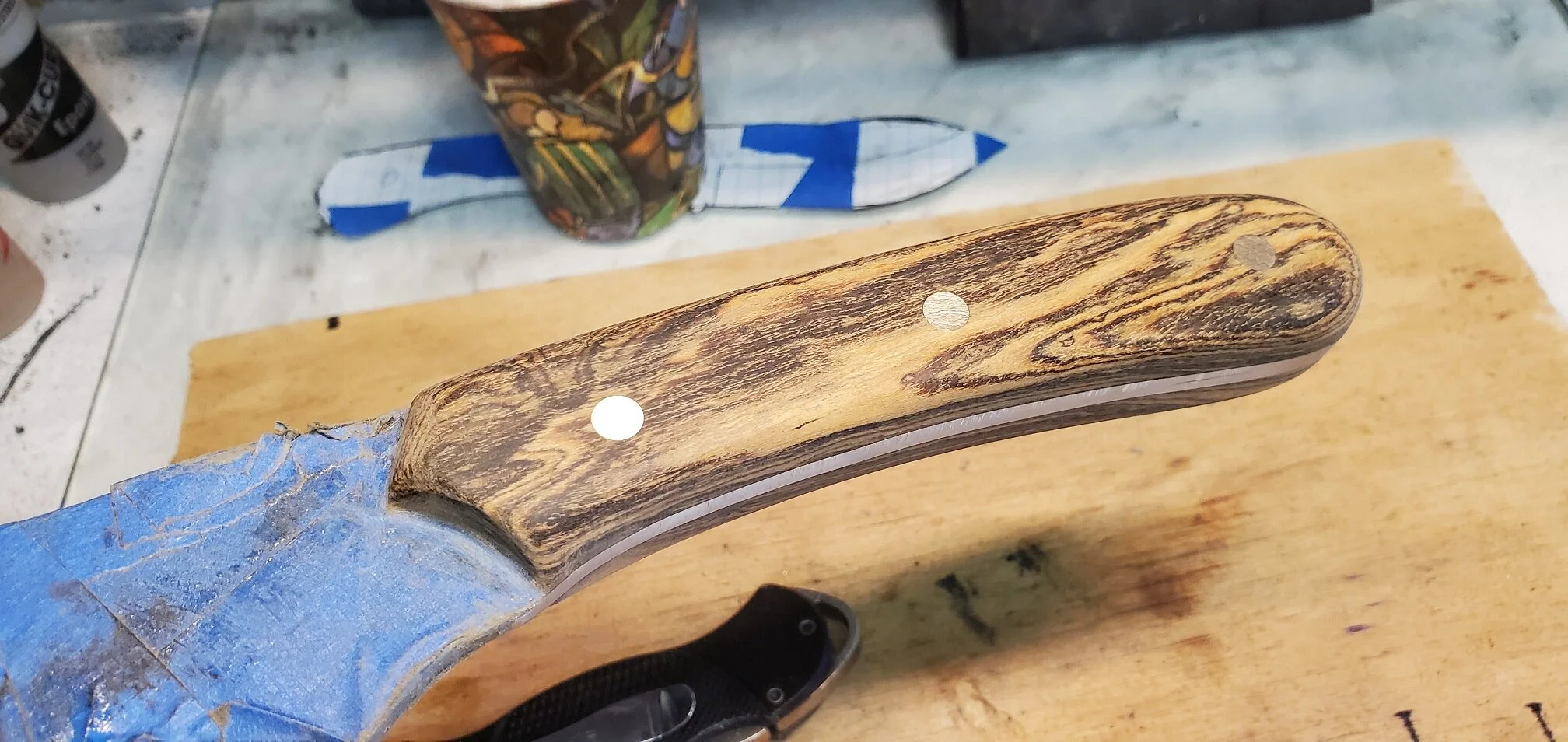
Getting the handle to shape took a lot of elbow grease, but I think it came out alright!

Next, I applied twice-boiled linseed oil… twice.

My friend had a chunk of burled wood from an olive tree given to him by another friend of his. I asked if I could use it for a base stand for the knife, and he said “sure!”. I was really excited, because the wood was ruggedly beautiful. He also had some wood blanks from different species, so I chose the walnut, cut it to size, cut a slot into it, put twice-boiled linseed oil on it, drilled a hole in its base (and in the olive burl), put a dowel, and viola!.. I had a stand for the knife.

Now all that’s missing is the knife itself..

Here’s the finished product.. side A.

…and side B.

